Merit: How Reputation Works on Bitcointalk
Before January 2018, Bitcointalk had a problem: account farming.
People would create hundreds of accounts, post nonsense to push them up the ranks, then sell those accounts to signature campaign managers who'd put them on the forum to spam advertisements. The signal-to-noise ratio was getting bad.
The solution was Merit — a system where rank advancement requires not just posting, but posting things other users actually value.
How it works
sMerit (sendable merit) is what members spend when they merit a post. Regular Merit — the number that counts toward rank — cannot be sent on to anyone else. The entire interface for this is a small +Merit link at the top right of each post, beside the quote button.
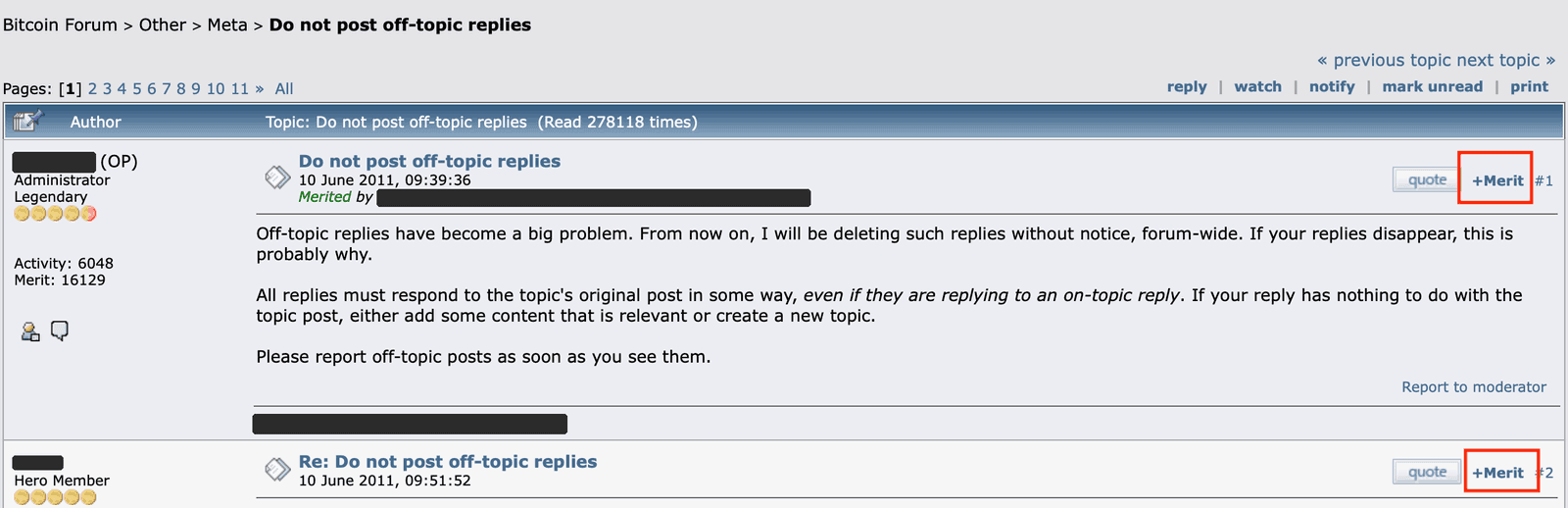
Merit is sent through the +Merit link at the top right of every post, beside quote — that small link is the entire interface for rewarding quality.
Bitcointalk screenshot · Usernames, the merited-by list and a Bitcoin address in a signature are solid bars flattened into the image; the red outlines are the operator's.
sMerit comes from two places. Receiving Merit earns you roughly half as much sMerit in return, so the people sending it are largely the people whose own posts have been valued. Separately, a set of designated Merit sources receive their own replenishing allocations to distribute.
When someone sends sMerit to a post, the author receives it as regular Merit, which counts toward their rank.
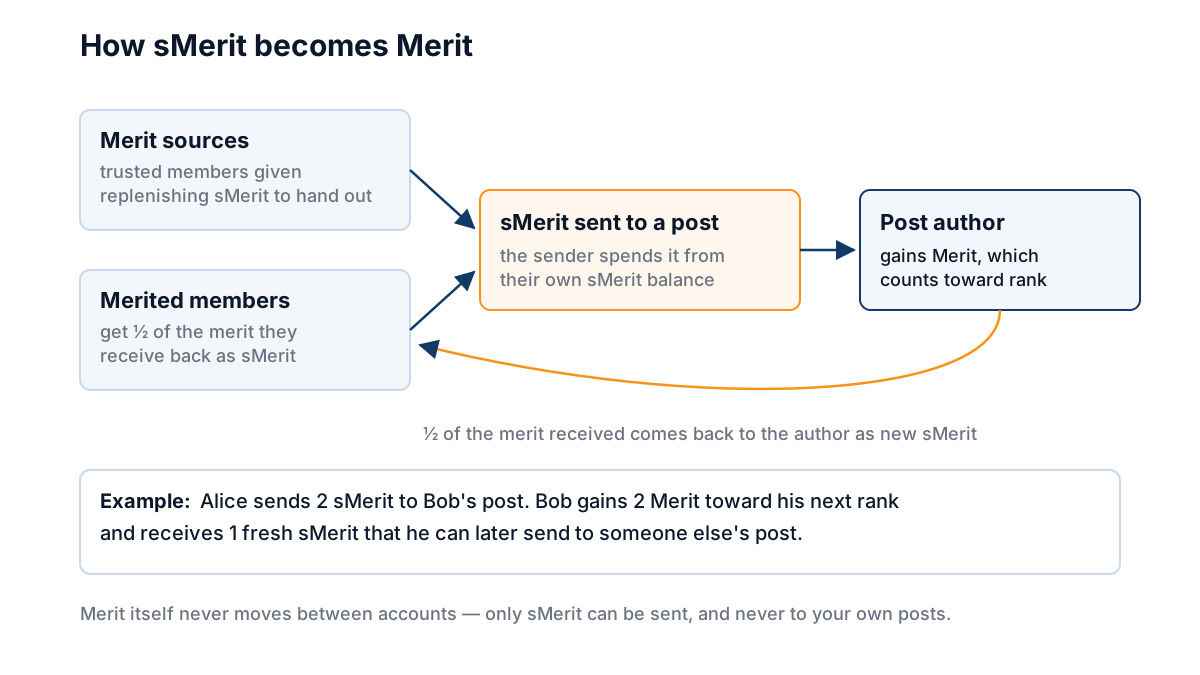
Only sMerit moves between users; the recipient's Merit counts toward rank, and half comes back as new sMerit, keeping the cycle going.
Academy original
This means:
- You can't farm merit on your own accounts
- Bot networks don't help (merit must come from real, active users)
- Quality matters more than quantity
How to earn merit
There's no formula. But there are patterns:
High-merit posts often:
- Provide actually useful information
- Cite sources or evidence
- Are well-written and clear
- Solve a specific problem someone has
- Document or explain something the community needs
Low-merit posts often:
- Are short and add nothing
- Restate something already said in the thread
- Are just opinions without reasoning
- Use AI to generate filler
- Are spammy or self-promotional
Long-time members widely credit the merit system with raising the average quality of posts across the forum — knowing that quality is measured changes how people write.
Common merit mistakes
"I'll just post a lot to get merit." No. You'll get less merit per post because experienced users will see you posting low-quality content and ignore you.
"I'll PM Legendaries asking for merit." This is begging. It works against you. Most senior users will refuse and may negatively rate you.
"I'll merit-trade with another user." This is against the rules and gets detected. You'll lose your merits and probably get banned.
"I'll copy good posts from elsewhere." This is plagiarism. Members run dedicated threads that report copied posts, and plagiarists get banned.
The honest path
- Find a topic you actually know about
- Post something useful in that topic's board
- Engage in threads where you have something to add
- Repeat for months
If your content is useful, merit will come. If it doesn't, your content probably isn't as useful as you think — read the highest-merited posts in the same board to understand the bar.
Checking merit
Click any user's merit number to see:
- Who has given them merit
- What posts received merit
- Their merit history over time
Your own merit page shows the same history plus how much sMerit you still have available to send.
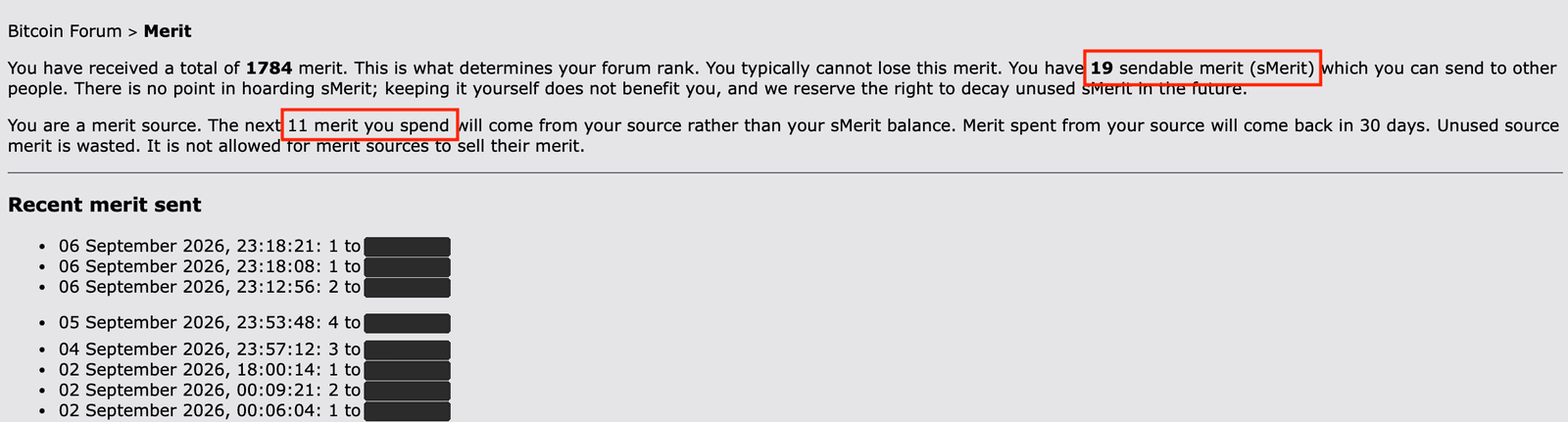
Your merit page shows the merit you have received, how much sMerit you can still send, and a dated history of the merit you have sent.
source · accessed 2026-09-07 · Recipients' usernames are solid bars flattened into the image; the red outlines are the operator's.
There are also community tools (covered later) that visualize merit flow and let you find quality posts in any board.